Crossware Contact Us →
Embedded cybersecurity

Security at every layer.
Evidence with every delivery.

Crossware helps OEM and product engineering teams implement embedded security across the BSP, middleware and application, with tests and traceability for the agreed requirements.

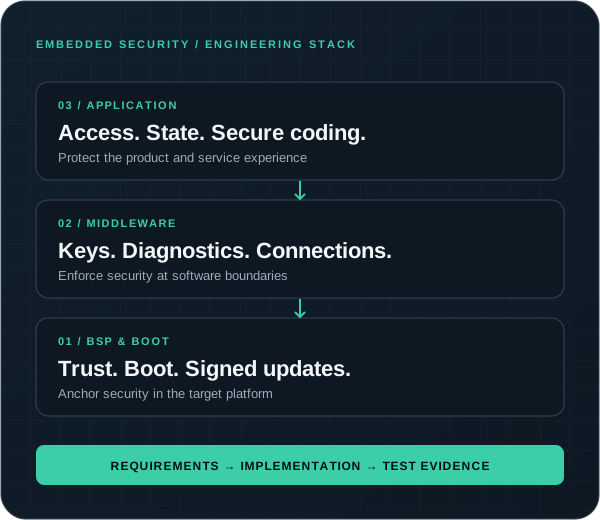
Three security layers: application access and state machines, middleware keys and diagnostics, and BSP secure boot and updates; each supported by implementation and test evidence.
One engineering scope, from boot chain to application.
Engineering scope

From a requirement matrix to working controls.

Bring a new platform, an OEM cybersecurity matrix or a specific security gap. We allocate the requirements, implement the agreed controls and verify their behaviour on the target system. Hardware capabilities and product risks shape the design.

Embedded LinuxAndroidRTOS & MCUOEM requirements
Technical building blocks

Secure the foundation. Protect the interfaces.

01

Secure boot & chain of trust

Integrate the hardware root of trust and image authentication into the boot chain. Define how the platform responds when verification fails.

Deliverables Boot-chain design, bootloader integration and negative-path test results.
02

Signed updates & recovery

Authenticate software packages and check integrity before activation. Design fallback or dual-bank recovery around the target hardware and update path.

Deliverables Update integration, recovery behaviour and interruption tests.
03

HSM & key management

Integrate hardware-backed cryptographic services where supported, including provisioning, non-exportable keys and controlled key deletion.

Deliverables Crypto-service interfaces, provisioning flow and lifecycle tests.
04

Platform hardening

Restrict debug and service interfaces, remove development protocols and reduce exposed services in production builds.

Deliverables Production configuration, interface policy and hardening verification.
05

Secure middleware & applications

Protect diagnostics, service-tool access, communication and stored data. Integrate authentication, role checks and secure application states.

Deliverables Integrated controls, interface tests and documented access rules.
06

Security verification

Apply scoped fuzzing, static analysis, white-box and penetration testing to external interfaces and trust boundaries.

Deliverables Findings, remediation checks and requirement-linked test reports.

Across the software stack

Clear ownership at every boundary.

01 / BSP

Establish trust

Bootloader, HSM drivers, production interfaces, peripheral firmware and update partitions.

02 / Middleware

Enforce the rules

Cryptographic APIs, diagnostics, key lifecycle, authenticated storage and connectivity services.

03 / Application

Respect the boundaries

Secure coding, role-based access, update user flows and protected state transitions.

Security in practice

Security controls, integrated into real products.

Two projects illustrate different parts of the embedded security scope: protected administration and updates on Embedded Linux, and a restricted operator environment on Android.

Embedded Linux / Device management

Secure administration on deployed devices.

The Embedded Device Management Platform connects a React interface through a Drogon C++ gateway to controlled host services. Browser-facing components are isolated from privileged device operations.

  • HTTPS, certificate handling and controlled routing.
  • Session controls, CSRF protection and password hardening.
  • Validated privileged operations.
  • Signed images, image validation and A/B recovery.
Explore the device management case study
Android / Device lockdown

A dedicated station with controlled access.

The Android Intercom Master Station turns commercial video-phone hardware into a dedicated operator device. The application becomes the launcher and dialler, keeping the operator within the intended product workflows.

  • Kiosk mode for dedicated station operation.
  • Protected settings and hidden system UI.
  • Controlled access to device hardware.
  • Unit tests and automated UI tests on target devices.
Explore the Android intercom case study
A reviewable delivery

Implementation, tests and an explicit compliance position.

  1. Assess & allocateReview product architecture, requirements and existing evidence. Identify gaps and agree ownership.
  2. Design & integrateImplement selected controls in the customer codebase, with documented interfaces and assumptions.
  3. Verify & resolveTest the agreed scope, address findings and update the risk analysis where included.
  4. Hand over & sustainDeliver traceability, test reports and a comply / partial / deviation position for the agreed requirements. Scope ongoing maintenance separately.
Choose your entry point

A focused work package or an integrated programme.

Gap assessment

A requirement allocation, gap list and delivery estimate to plan the engineering work.

Layer-specific delivery

Target a defined need such as secure boot, HSM integration or diagnostic access control.

Implementation & verification

Coordinate controls across layers, or commission a scoped review of existing software.

Start with your product

Which security requirement is holding up your product?

Share your target platform, software stack and security requirements. We will define the implementation scope and the evidence your team needs.