
Power-on to usable display
Qt 6 startup with security verification enabled.
Ready for what regulators will ask
For a vehicle manufacturer, Crossware built a connected display on STM32MP257 with a verified boot chain and signed, encrypted USB updates. The platform reaches a usable Qt 6 display in 3 to 4 seconds, with security checks enabled.
Qt 6 startup with security verification enabled.
Successive boot stages authenticate the next software stage.
USB packages are authenticated, decrypted and checked before installation.
Return to a working image while preserving separate user and map data.
Disallowed older versions are rejected.
Modified images, interrupted updates, static analysis and CVE scanning.
Modern vehicle displays pair with phones over Bluetooth, connect over Wi-Fi and receive software in the field. The manufacturer set three goals for the product:
Crossware addressed boot time and security together across the stack, keeping verification enabled while optimising the path to the first usable display.
Crossware took ownership of the software stack from the STM32MP257 boot chain to the Qt 6 display. The design combines a hardware trust anchor, boot-stage authentication, a minimal Linux platform and protected field updates.
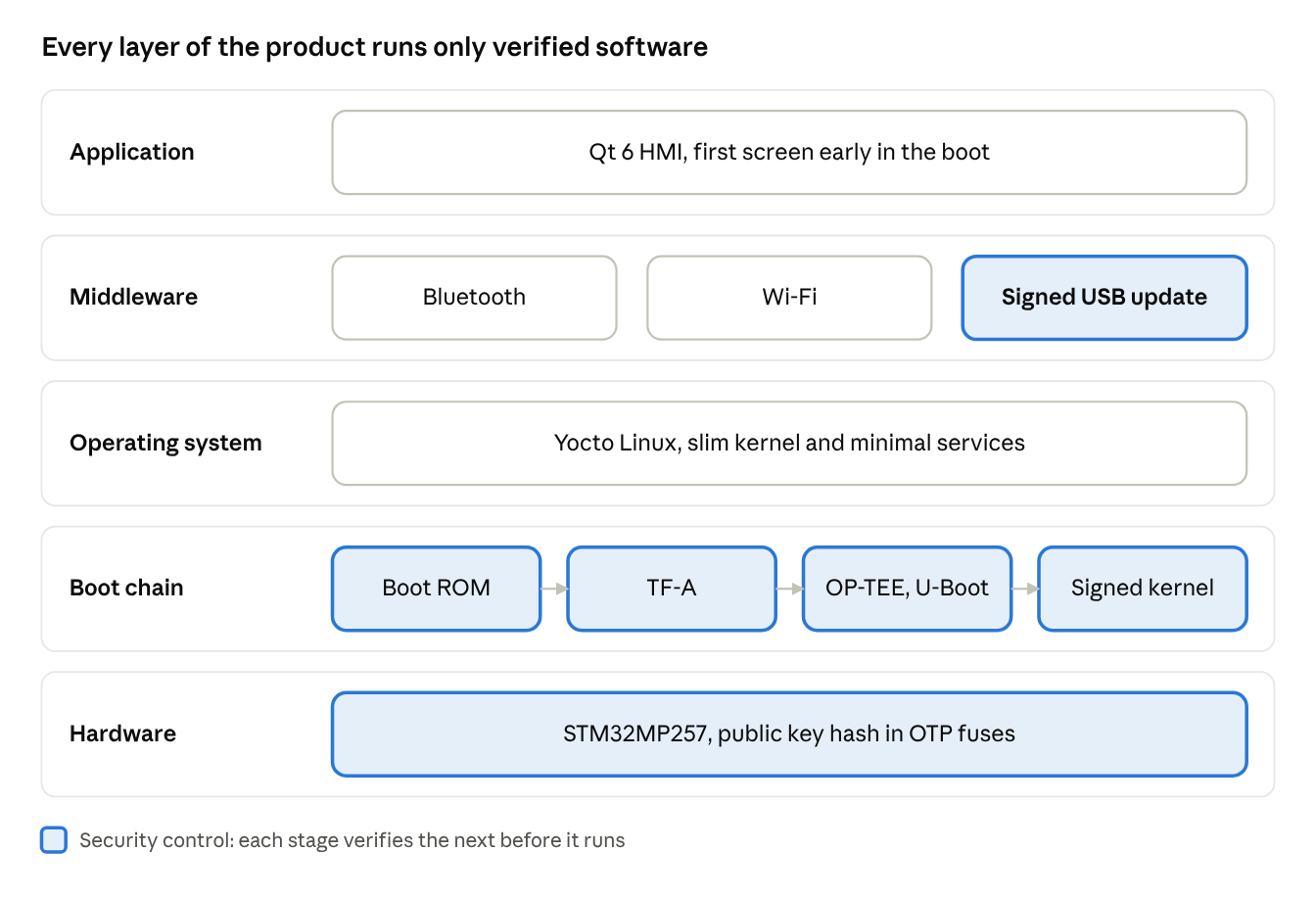
Trust starts in the processor. Boot ROM authentication anchors the early boot stages; subsequent checks extend the chain to the signed kernel. Updated software passes through boot verification before execution.
The STM32MP257 Boot ROM authenticates the first-stage bootloader using verification material anchored in the chip’s one-time programmable memory. The subsequent chain covers secure firmware, U-Boot and the signed Linux kernel. A failed signature check causes the affected image to be refused.
The reported 3–4 second startup was achieved with verification enabled. Crossware optimised bootloader stages, reduced the kernel to the drivers required by the product, built a minimal Yocto image and prioritised the driver display. Bluetooth and Wi-Fi start in the background.
The dealer and service workflow uses USB packages. RAUC integration coordinates installation and software-partition switching.
Verify the release signature before installation so modified or unauthorised packages are rejected.
Protect package contents on the USB update medium.
Install the new image alongside the running version and recover to a permitted working image if installation or first boot fails.
Reject disallowed older signed versions to prevent reintroduction of vulnerable software.
Keep persistent data on dedicated partitions outside the A/B slots, preserving settings and maps through updates and recovery.
After an update, the new software re-enters the same verified boot chain.
Debug ports, remote shell access and unused services were disabled in the production build. Static code analysis and dependency CVE scanning supported the release review and remediation work.
Bluetooth, Wi-Fi and the Qt 6 interface run on the verified platform. Boot authentication protects against replacement with unauthorised images; production hardening reduces exposed services and access paths.
Validation focused on the failure cases that matter during boot, field installation and recovery.
| What we tested | What it shows |
|---|---|
| Booting modified and unsigned images | Unauthorised images are refused by boot verification. |
| Installing tampered USB packages | Invalid packages are rejected before installation. |
| Cutting power during an update | Recovery to a working software image. |
| USB workflow and RAUC partition switching | Installation and A/B switching validated. |
| Production port and service review | Debug and remote-access entry points checked against the production configuration. |
| Static analysis and CVE scanning | Code and component findings identified for remediation. |
| Power-on to first screen | A usable display in 3–4 seconds with security verification enabled. |
The project’s security context includes UN R155, UN R156 and ISO/SAE 21434. Its implementation provides technical evidence around protection against unauthorised software, authenticated updates, recovery, hardening and verification.
BSP, boot chain, middleware and HMI addressed as one engineering scope.
Startup optimised while keeping verification enabled.
Controls supported by tests of expected behaviour and failure paths.
Scope the approach against your hardware’s security features, software stack and OEM requirements.
This project is one example of Crossware’s cybersecurity services across BSP, middleware and application layers.
Talk to us about secure boot, signed updates and fast-boot engineering for your platform.