
The challenge
An embedded IVI needed to present content from Android and iOS devices over wired and wireless links while preserving usable latency and image quality. Connection stability, touch mapping and coexistence with the native Qt interface were as important as the video stream itself.
Architecture evaluation
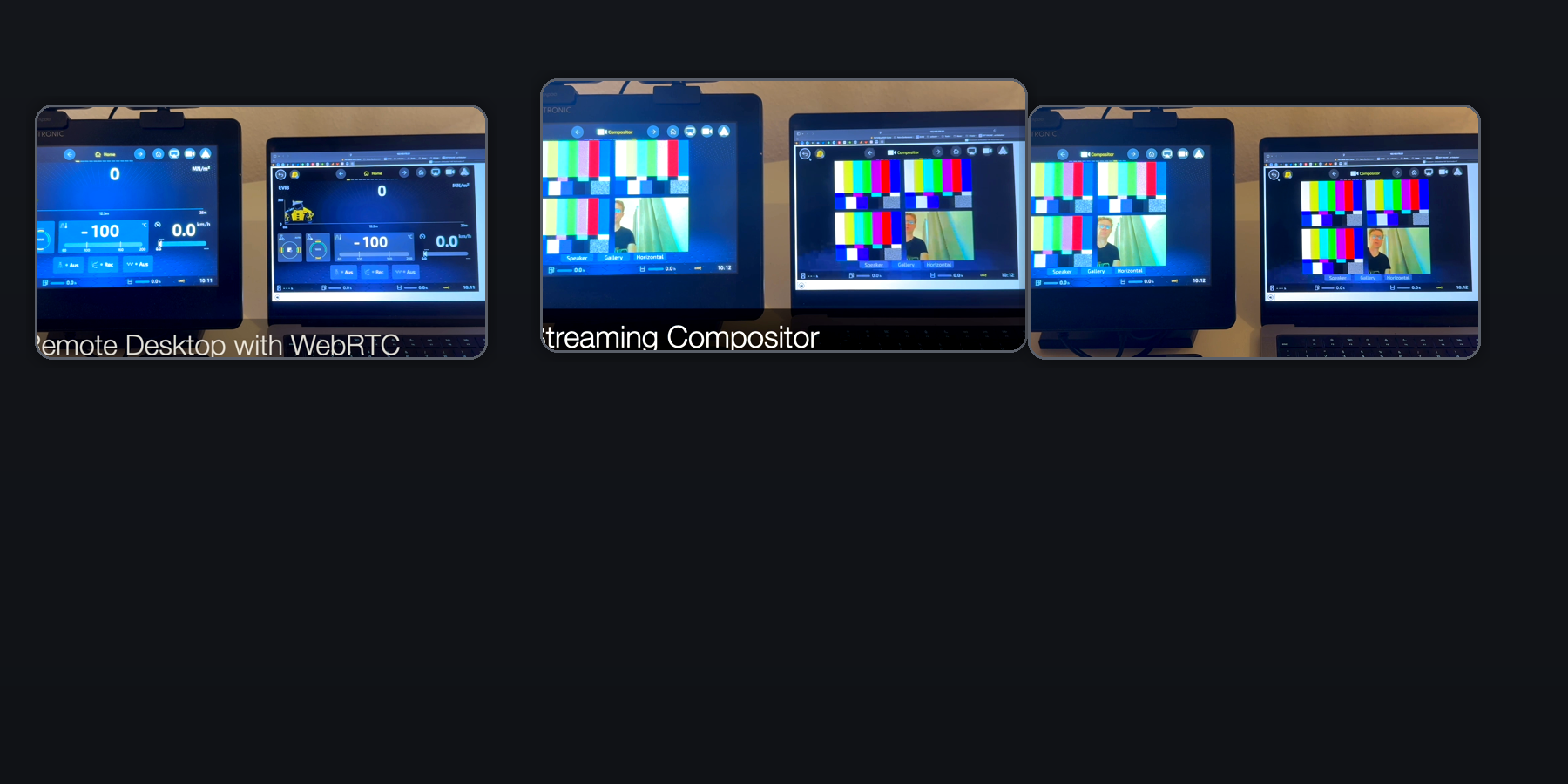
Crossware compared USB transport, Miracast-style wireless projection, TCP streaming and WebRTC against platform support, achievable latency and integration effort. For Apple devices, the architecture covered discovery, control and media transport across the relevant AirPlay services.
Engineering approach
A dedicated mirroring service built around GStreamer receives and decodes the mobile video stream, renders it into a controlled region of the IVI and forwards interaction back to the connected device. Platform abstraction keeps transport-specific behaviour outside the Qt application.
Delivered capabilities
- Android and iOS integration approaches
- Wired and wireless screen transport
- Low-latency decode and embedded rendering
- Touch-event mapping between display coordinate spaces
- Service-oriented integration into an existing Qt HMI
- Performance, stability and target-hardware validation
Outcome
The architecture provides a realistic route to connected mobile content without replacing the embedded HMI. Protocol complexity remains isolated while the product interface retains ownership of layout, lifecycle and core functions.