
The challenge
An off-highway vehicle interface required a grounded assessment of HUD technologies and a robust method for drawing steering-dependent guidelines over a live rear-camera feed. Outdoor readability, vibration, heat, optics and video latency all affected whether the concept could become a dependable product feature.
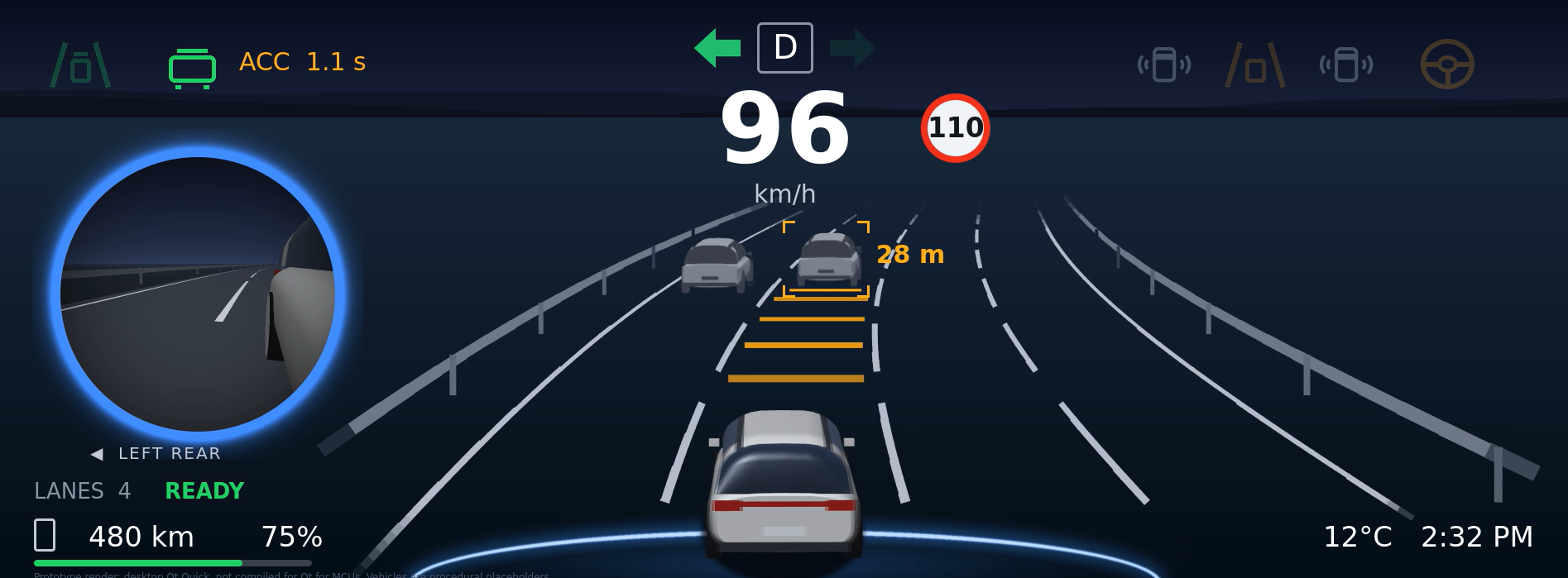
Engineering approach
Crossware compared display approaches including projection and direct-view technologies against brightness, field of view, thermal behaviour, packaging and mechanical constraints. In parallel, the camera-overlay architecture connected steering information with calibrated geometry, frame synchronisation and low-latency rendering.
From steering angle to trusted guidance
Dynamic guidelines must represent the expected vehicle path rather than act as a decorative overlay. The rendering model therefore accounts for calibration parameters and steering input, while a diagnostic view supports tuning and verification. Camera timing and composition are handled explicitly so guidance remains aligned with the live image.
Engineering scope
- HUD technology and system-integration assessment
- Outdoor visibility, vibration, thermal and optical evaluation
- Steering-angle input through the vehicle network
- Dynamic guideline geometry and calibration workflow
- Real-time camera composition with defined latency targets
- Diagnostic support for commissioning and validation
Outcome
The work provides a defensible technical route from an attractive interface idea to an implementable assistance feature. Final delivery claims depend on the selected hardware and programme phase; the case therefore describes the engineering assessment and architecture rather than implying production deployment.